Menu Design That Balances Guest Choice, Kitchen Capacity, and Profit
Restaurant operators must decide which choices to present and emphasize before approving a menu, because the wrong visual priority appears during service as slower decisions, overloaded stations, modifier errors, and weak contribution. The problem becomes visible when an expo watches grill tickets accumulate after a promoted steak generates a rush of doneness requests and side swaps.
Effective menu design begins with an operating brief, not a template
Effective menu design starts with a written operating brief that defines the service format, guest, financial target, production limits, physical conditions, and revision process before anyone chooses typography or visual emphasis.
What must a restaurant define before starting menu design?
The chef, general manager, and service manager should approve a one-page brief covering:
- Concept and service model: dayparts, full service, counter service, bar, pickup, delivery, and other ordering channels.
- Guest and financial targets: primary guest groups, expected price level, average-check target, and intended meal duration.
- Ordering conditions: item count by category, menu dimensions, table size, ambient lighting, and typical reading distance.
- Production limits: stations, staffing assumptions, equipment constraints, preparation sequence, and ticket-time goal.
- Communication controls: dietary and allergen language, modifier rules, unavailable-item procedures, and escalation points.
- Production cycle: print quantity, update frequency, approval owner, revision budget, and effective date.
A steakhouse brief might specify dinner and weekend lunch, dining-room and pickup channels, six production stations, peak staffing by station, a target ticket-time range, a two-page printed menu, and quarterly reviews with interim price inserts. The brief records assumptions so designers do not disguise operational choices as decoration.
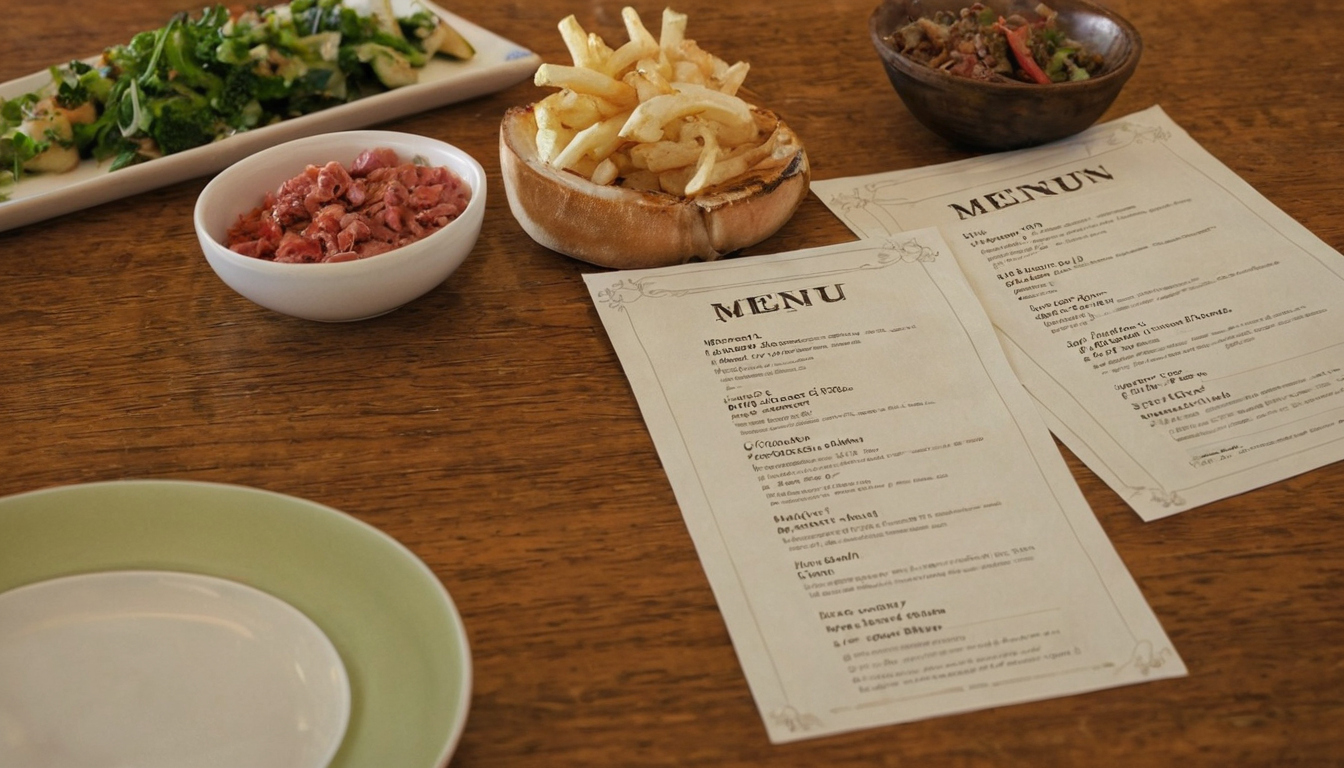
Effective menu design begins with an operating brief, not a template shown with practical context cues.
Menu design requirements change by ordering channel
A printed menu must withstand table lighting, handling, cleaning, and storage. A wall board needs short names and grouping that works at a distance. A QR menu needs responsive text, logical headings, keyboard access, and screen-reader support. The U.S. Department of Justice identifies WCAG and the Section 508 Standards as helpful web-accessibility resources, although those references do not resolve every compliance question for a private restaurant. Kiosks require touch-friendly controls, while delivery platforms impose separate structures for modifiers, images, prices, and availability.
Moisture also affects storage and menu stock. The U.S. Environmental Protection Agency advises fixing wet or damp spots promptly to prevent mold growth in its residential moisture guidance, although that document is not a restaurant menu-maintenance standard. Once the operating constraints are defined, the operator can address choice friction without relying on an arbitrary item limit.
Menu design should reduce choice friction without imposing an arbitrary item limit
Menu design should reduce search effort without assuming that fewer items are always better. The appropriate number depends on guest familiarity, dietary needs, product differences, service speed, and ordering channel.
How many choices should restaurant menu design present?
A broad menu may suit repeat visitors, mixed dietary needs, or configurable products, while the same breadth can delay unfamiliar guests at a counter. Diagnose friction through ordering time, abandoned searches, repeated server questions, overlooked options, and low-selling items. Compare those signals with a representative POS sales mix rather than applying a universal item-count rule.
Menu categories should match how guests compare items
Category labels should describe the decision guests are making, not an internal station or vague culinary distinction. Overlapping groups such as “From the Grill,” “House Specialties,” and “Chef Selections” may require guests to search repeatedly. Grouping by protein, portion, meal format, or another meaningful difference can make comparison easier.
Ask representative guests to sort item cards, find dietary options, and explain category labels. Then compare the proposed structure with server questions and attachment opportunities for beverages, sides, and sauces. The next control is deciding which options deserve emphasis without overwhelming a station.
Menu design can protect kitchen capacity by controlling what receives emphasis
Menu design protects kitchen capacity when promotion reflects demand, active work, equipment limits, holding tolerance, and synchronization risk rather than contribution margin alone.
A menu design station-load matrix reveals risky promotions
The following values are illustrative, not observed data. The example assumes a dinner peak with two grill cooks, one cook at each other station, and one expo.
| Item | Expected demand per 30 minutes | Primary station | Active work per order | Equipment constraint | Holding tolerance | Synchronization risk |
|---|---|---|---|---|---|---|
| Ribeye | 12 | Grill | 4 minutes | Grate space | Low | High |
| Skirt steak | 9 | Grill | 3 minutes | Grate space | Low | High |
| Fried chicken | 8 | Fryer | 2 minutes | Basket capacity | Medium | Medium |
| Mushroom pasta | 7 | Sauté | 5 minutes | Burners | Low | High |
| Chopped salad | 10 | Cold station | 2 minutes | Assembly space | Medium | Low |
| Chocolate cake | 6 | Pastry | 1 minute | Plating space | High | Low |
Menu modifiers can overload the kitchen
POS and kitchen-display reports should expose modifier frequency, corrections, voids, remakes, and comps. Risk triggers include:
- Side swaps that transfer work to another station
- Doneness choices that complicate grill sequencing
- Add-ons requiring separate cookware or extra firing time
- Allergy requests unsupported by verified cross-contact controls
Compare typical and peak-period ticket times by item, station, daypart, interval, and channel before increasing prominence. A persistent constraint may require different preparation, fewer modifiers, revised accompaniments, limited availability, equipment changes, or more labor. Capacity controls must then be supported by clear descriptions, prices, and allergen communication.
Menu design must make descriptions, prices, modifiers, and allergens understandable
Menu design should make essential information easy to interpret without promising controls the restaurant cannot maintain.
| Topic | Clarity practice | Requirement to verify |
|---|---|---|
| Descriptions | Name the product, preparation, important accompaniments, portion distinction, and consequential modifiers. | Substantiate provenance, preparation, and dietary claims. |
| Prices | Place prices consistently and disclose modifier charges before confirmation. | Check applicable rules for taxes, mandatory fees, service charges, delivery prices, and large-party pricing. |
| Calories | Keep required figures legible without obscuring comparison. | FDA requirements for covered establishments include calories for standard items, written nutrition information on request, and a statement referencing 2,000 calories per day while noting that calorie needs vary. |
| Digital access | Provide readable contrast, logical navigation, and text alternatives. | The U.S. Department of Justice states that ADA Title III applies to web content from businesses open to the public, subject to the entity and service involved. |
Allergen communication requires controlled recipes and procedures
U.S. federal law identifies nine major food allergens: milk, eggs, fish, crustacean shellfish, tree nuts, peanuts, wheat, soybeans, and sesame. Sesame became the ninth major allergen on January 1, 2023. Restaurant obligations can also depend on state and local rules.
An allergen icon remains reliable only when recipes, suppliers, substitutions, storage, utensils, surfaces, grills, and fryers are controlled. The FDA explains that allergen cross-contact can unintentionally introduce an allergen into another food. Local requirements must be confirmed because the 2022 FDA Food Code is a model code offered for adoption, not federal law automatically governing every restaurant.
Menu design must make descriptions, prices, modifiers, and allergens understandable shown as an editorial planning reference.
Profitable menu design measures contribution, workload, and guest response together
Profitable menu design evaluates each item as a combined financial and operational decision rather than assigning a simplistic popularity or margin label.
A menu design decision table should show more than food-cost percentage
For one consistent sales period, compare contribution margin, cost volatility, labor, waste, station congestion, attachments, discounts, stockouts, and guest response. Define contribution margin consistently, such as net selling price minus recipe and packaging costs.
| Illustrative item | Price and cost | Station load | Guest signal | Decision |
|---|---|---|---|---|
| Grilled steak | $32 and $13 | High | Strong wine attachment; timing complaints | Reduce peak-period emphasis |
| Roast chicken | $24 and $8 | Moderate | Strong side attachment; positive feedback | Retain |
Price changes should be tested against sales mix, discounting, comparable local offers, complaints, and satisfaction while portion specifications remain constant. Once the decisions are sound, the production tool must preserve them accurately.
Which menu maker or menu creator fits restaurant production requirements?
A menu maker or menu creator fits restaurant production only if it supports reusable styles, controlled updates, approval history, accessible digital output, and print-ready exports.
A restaurant menu maker should pass a production checklist
- Export a test file and ask the printer to check fonts, images, bleed, transparency, and color.
- Confirm global price editing, version history, permissions, and location-specific variants.
- Review licensing, commercial rights, collaboration controls, data retention, and accessible output.
- Record the evaluation date because software features, terms, and prices change.
A menu layout free template may suit a small menu only after the operator checks output quality, commercial-use rights, data terms, and revision costs. AI can draft descriptions, categories, and layouts, but chefs and managers must verify recipes, allergens, prices, station capacity, disclosure duties, and printer output.
Print specifications determine whether menu design survives service
The printer should define trim, bleed, safe area, folds, resolution, color mode, stock, coating, binding, proofing, and minimum order. Test samples under actual lighting and cleaning routines. ENERGY STAR states that qualified LED lighting uses at least 75 percent less energy and lasts up to 25 times longer than incandescent lighting, where qualified products apply, but on-table testing is still needed to detect glare. Menus used with outdoor seating and peak-service conditions also require wind, moisture, storage, and wipe-down testing.
Menu design should be piloted in real service before full rollout
Menu design should be tested under intended service conditions before a full print run or permanent digital launch.
A menu design pilot needs operational and guest-facing measures
Record baseline and pilot dates, dayparts, channels, staffing, traffic, promotions, stockouts, weather where relevant, and the version each guest received. Assign versions across comparable periods or tables rather than comparing a busy Saturday with a quiet Monday.
Menu design should be piloted in real service before full rollout shown as an editorial planning reference.
- Use POS data to track item mix, average check, modifiers, voids, and ordering time where captured.
- Use kitchen-display records for ticket and station times, with waste logs for remakes and discarded preparation.
- Use server observations and brief guest questions to identify confusing descriptions, missed items, price uncertainty, and dietary questions.
- Test legibility, glare, cleaning, opening, and page handling at occupied tables. Include table dimensions, chair comfort, and long guest sits in the physical review.
Set proceed, revise, and stop thresholds before service. A sales increase should not approve a menu that also creates unacceptable modifier errors, remakes, station delays, or guest confusion.
Menu design rollout requires version control and staff training
Give every approved file a version number and effective date. Assign owners to final proofing, POS buttons, kitchen tickets, recipes, online listings, printed stock, and staff briefing. Training should cover new and removed items, prices, modifiers, allergens, substitutions, and consistent answers to likely questions.
Schedule a post-launch review and withdraw obsolete copies from every channel. Approve visual emphasis only after guests can decide confidently and the restaurant can fulfill those decisions reliably.
Frequently asked questions about menu design
What is the 30/30/30 rule for restaurants, and is it a reliable basis for menu design?
The phrase has no single, generally accepted menu-design definition. Operators should not use it as a substitute for POS analysis, station-capacity review, recipe costing, guest testing, and applicable disclosure requirements.
What is the Golden Triangle in menu design, and does current evidence support using it?
The Golden Triangle is a common claim that guests look first at the center, then the upper-right and upper-left areas of a menu. It should not determine placement without testing because reading behavior changes with page size, format, category structure, language, device, and guest intent.
Can AI design a restaurant menu without help from a chef, operator, or printer?
No. AI can produce drafts, but qualified people must verify recipes, pricing, allergens, modifiers, station effects, legal disclosures, accessibility, licensing, and print specifications.
Frequently asked questions about menu design shown as an editorial planning reference.